

September 8, 2026
$1.55m grant to unlock hidden capacity in Australia’s electricity networks
UOW researchers work with industry partners on system that identifies bottlenecks and redirects power to where it’s needed most
ÁñÁ«ÊÓƵapp of ÁñÁ«ÊÓƵapp (UOW) researchers will provide technical leadership on a major project that aims to tackle one of the electricity grid’s most persistent problems: bottlenecks. These occurs when electricity flow is constrained in one part of the network, even though capacity exists elsewhere.
Researchers from UOW’s Australian Research Council (ARC) Training Centre in Energy Technologies for Future Grids will play an instrumental role in the project titled, ‘Unlocking the Latent Network Capacity via Soft Open Point and Dynamic Limit’. The aim is to find and use spare capacity that already exists within the electricity network but currently goes unused. It does this through Soft Open Points, smart devices that flexibly redirect power to where it is needed, and Dynamic Limits, which safely adjust capacity based on actual network conditions.
The project was awarded $1.55 million from the Australian Government’s Grid Enhancing Technologies Grant Program for the development of an intelligent decision-support system that would help deliver more renewable energy to consumers. It is one of 14 projects supported through the $30 million program to strengthen the nation’s electricity grid.
The system will give network operators a broader view of the grid, forecast emerging constraints, and identify safe options for redirecting electricity flows around network bottlenecks to make better use of existing capacity.
“In Australia’s power system, one part of a network can be under pressure while unused capacity exists nearby. We need better ways to redirect energy flows using existing infrastructure. Our aim is to give network operators greater capability to identify and make use of available network capacity,” said , Director of the ARC Future Grids Training Centre.
“Every recommendation will be validated before implementation allowing greater network capacity while maintaining the safety and reliability of the power system,” he added.
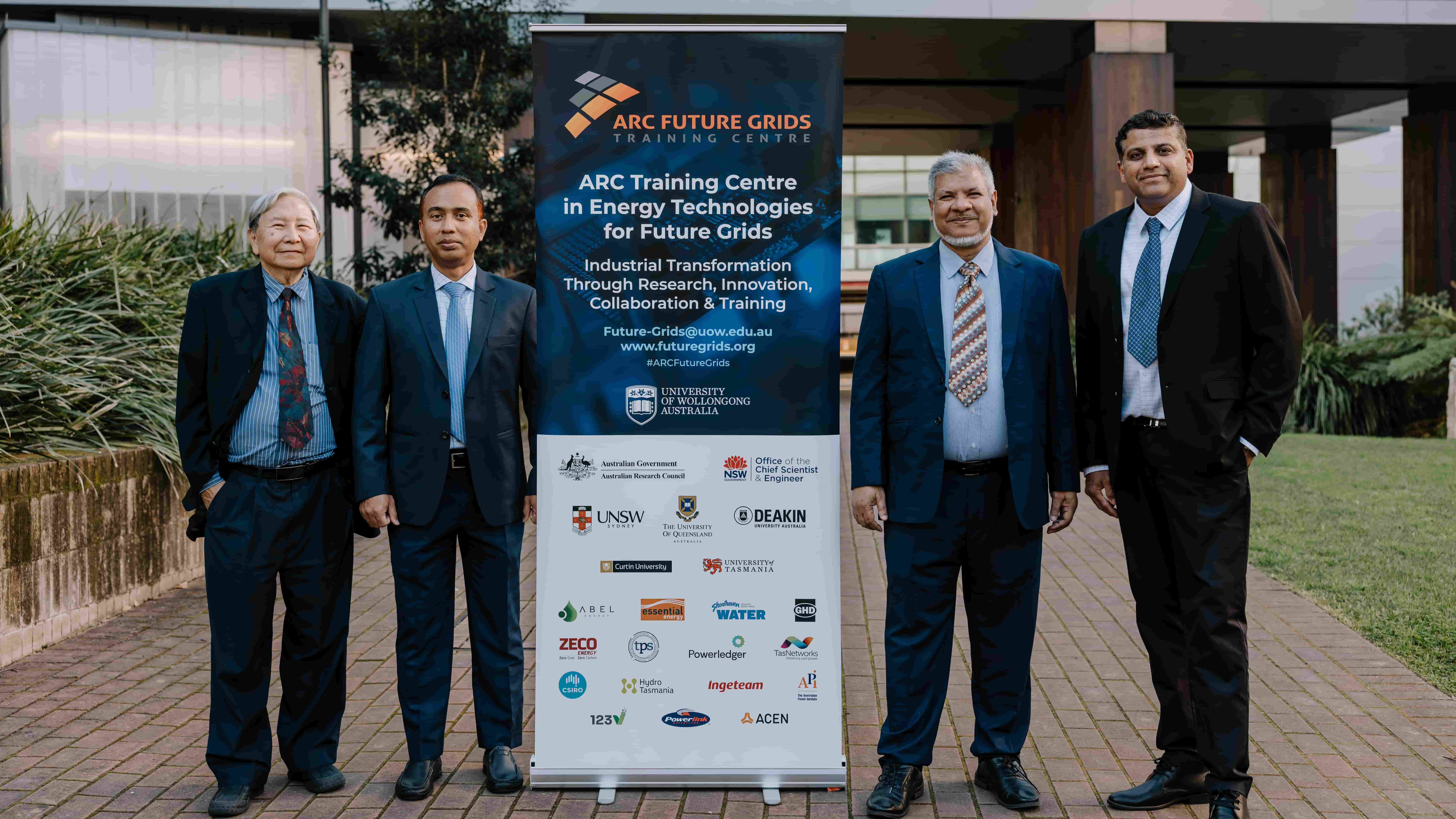
UOW researchers Professor Muttaqi, , , and , will work alongside and industry partners , , and .
will lead project delivery and system integration, while UOW will provide technical leadership in network modelling, optimisation, digital twin development, laboratory validation and field testing.
The team will also develop a repeatable deployment pathway to support adoption across Australian electricity networks and help accelerate Australia’s transition to net-zero by 2050.
The project reflects the ARC Future Grids Training Centre’s commitment to translating research into practical technologies through close collaboration with industry.
About the ARC Future Grids Training Centre
The ARC Future Grids Training Centre is an Australian Research Council Industrial Transformation Training Centre, led by the ÁñÁ«ÊÓƵapp of ÁñÁ«ÊÓƵapp. The Centre brings together leading universities and industry partners to develop innovative technologies and train the next generation of engineers and researchers to support Australia’s transition to a secure, reliable and sustainable electricity system.